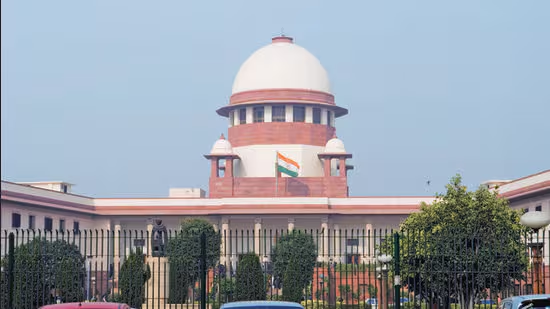
In a strong and rare rebuke, the Supreme Court has described the air pollution control plan prepared by the Commission for Air Quality Management (CAQM) as a “total failure,” sending a clear message that cosmetic solutions will no longer be accepted. This important environment news comes at a time when residents of Delhi-NCR continue to struggle with toxic air despite years of policies, meetings, and emergency measures.
During the hearing, the top court expressed deep dissatisfaction with the way air pollution is being handled in the national capital region. The judges observed that every year, authorities come up with similar plans, yet the results on the ground remain unchanged. According to the court, the recurring spike in pollution levels proves that the existing approach lacks seriousness, enforcement, and accountability.
This Supreme Court news highlights a long-standing concern: air pollution in Delhi-NCR is no longer a seasonal problem but a permanent public health crisis. The court noted that citizens are forced to live with hazardous air quality year after year, raising serious questions about governance and responsibility.
The bench made it clear that merely issuing directions, holding review meetings, or blaming neighbouring states will not solve the crisis. The judges stressed that a plan without strict implementation is meaningless. They instructed CAQM to revisit its entire strategy and prepare a fresh, comprehensive, and practical roadmap that delivers visible results, not just paperwork.
In its observations, the Supreme Court underlined that the right to clean air is closely linked to the fundamental right to life. This breaking news reinforces the idea that environmental protection is not optional but a constitutional duty. The court warned that continued inaction would have long-term consequences for public health, especially for children, the elderly, and those with respiratory illnesses.
The court also questioned why past measures failed despite the availability of data, scientific research, and technological solutions. It emphasised the need for coordination between central, state, and local authorities, noting that fragmented efforts only worsen the situation. According to the judges, effective pollution control requires shared responsibility and firm decision-making.
This latest Delhi pollution news has renewed public debate on whether authorities are genuinely committed to solving the problem or simply reacting when conditions become critical. Environmental experts have long argued that temporary bans, odd-even schemes, and emergency responses do little to address the root causes of pollution, such as vehicular emissions, industrial activity, construction dust, and stubble burning.
The Supreme Court’s directive is expected to push CAQM to focus on long-term, sustainable solutions rather than short-term crisis management. The court has asked the commission to submit a revised plan that clearly defines accountability, timelines, and measurable outcomes.
For millions living in Delhi-NCR, this latest news offers a glimmer of hope that the judiciary’s intervention could finally lead to meaningful action. However, the court also made it clear that words alone will not be enough. Real change will depend on whether authorities act decisively and consistently.
As the case continues, all eyes will be on CAQM’s next move. The Supreme Court’s message is loud and clear: failure is no longer acceptable when public health and lives are at stake.