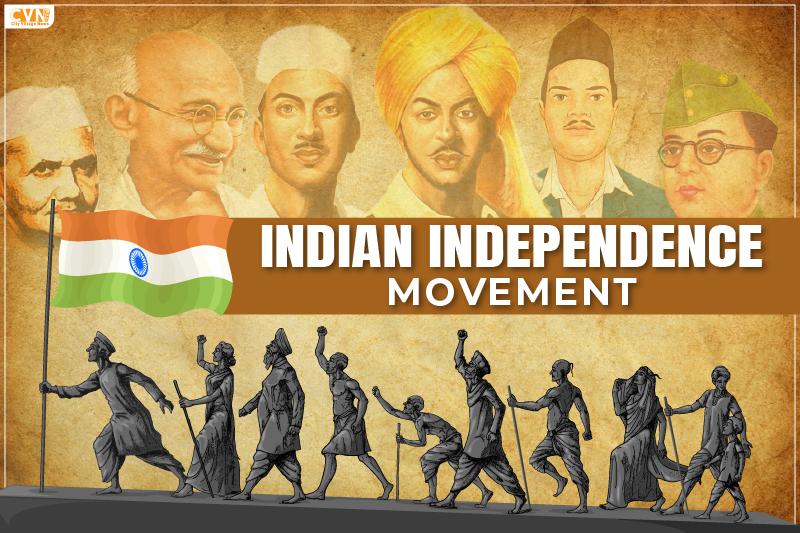
The Indian Independence Movement:
A Tale of Daring, Cohesion, and Immutable Hope. The Indian independence was not only a political battle, it was a long, emotional and changing process that changed the fate of millions. It spanned over several decades, affected many lives and united individuals of all parts of the subcontinent. The struggle of freedom was not always easy and it was filled with sacrifices, failures, and new determination. But, despite everything, this dream of an independent India was still like a burning flame that could not be doused by a storm.
In order to fully appreciate the freedom struggle in India, it is important to view India, not as a series of events but as a human story. It was an account of common men doing amazing things, of leaders who made people hope even when all seemed hopeless, and of the civilization regaining its own strength.
Antecedents of Dissatisfaction and the First Sparks of Resistance.
The independence movement had planted the seed of the movement way before the actual uprising. By the middle of the 19 th century the British rule had gripped India. They exhausted the wealth of India, undermined the local industries, and destabilized the traditional social system. Farmers were over taxed, artisans were left jobless as machines produced their goods in Britain and the Indian soldiers in the British army were being pressured on a daily basis.
The Revolt of 1857 was the first significant coup against colonialism.
This rebellion was unsuccessful, but it brought together soldiers, peasants and local rulers under one voice of a rebellion.
It exposed a great reality- that Indians were ready to fight to defend their land and honor. The insurrection was a turning point and the British suppressed it but at the same time the urge to gain self rule had started to form. The awakening of the National Consciousness.
Towards the end of the 19 th century, educated Indians began to perceive the exploitation of the colonialists more vividly. Other economists such as Dadabhai Naoroji unveiled the Drain of Wealth, proving how the British rule was enriching India with poor leadership. The awareness of politics increased gradually and organizations such as the Indian National Congress which was established in 1885 provided a platform of communication and collective demand. During the initial years, the Congress leaders thought that reforms were possible by use of petitions and through the constitution.
However, as the British began to become apathetic the younger generation started to insist on more active action. New wave of national spirit was created with bold statements by such leaders as Bal Gangadhar Tilak who proclaimed, Swaraj is my birthright and I will have it. The revival of the culture was no less significant. Indian pride in its heritage, literature, and philosophy were the movements that made people closer to each other emotionally. It is this cultural coherence that gave rise to political coherence in the future.
Gandhi and the Struggle Revolution.
In the year 1915, Mahatma Gandhi returned to India after spending some time in South Africa and the freedom struggle got dramatic. Gandhi was a personality who was able to find a way to communicate with people regardless of their caste, classes, and language barriers. He also addressed not only the political rationale but the human one as well, the truth, non-violence, and moral courage.
During his leadership, the movement was more accommodating. Farmers, workers, students, women and even the poorest citizens appeared to be active participants, first time. A resistance through non-violence was morally potent, and the British could not withstand it because of the philosophy of Gandhi who provided them with a means to fight without using a gun.
The Non-Cooperation Movement in 1920 made the British realize that India was no longer a passive country. The Indians started insisting on their independence in their daily lives which started with boycotting the foreign goods and then denying the government jobs and honours. In spite of the fact that the movement was cancelled following Chauri Chaura incident, it initiated the mass participation.
A Ten-year Test of Will Salt, Courage, and Civil Disobedience.
The independence struggle was characterized by the 1930s. Gandhi used the salt tax as a symbol of injustice when the British made it mandatory to pay taxes on salt which they all needed as an ingredient. His Dandi March in which he walked 240 miles to get salt at the seashore shocked the whole country. It was a mere gesture though a deep symbolic gesture. It informed all Indians, both rich and poor, that they could be free, with one step.
The succeeding Civil Disobedience Movement was characterized by thousands of people defying unjust laws in a peaceful manner. Citizens flocked in jails, thinking that it was a minor sacrifice to be put in prison to be free.
Women such as Sarojini Naidu, Kamaladevi Chattopadhyay and thousands of nameless village women took a step towards leadership with composure and bravery. The British rule repressed them but each arrest reinforced the movement even more. Hope had diffused all over the nation as never before.
The Quit India Movement: India hears the Last Roar.
In 1942, the World War II was in full swing and the British were counting on the unconditional support of India. But now Indians were impatient. They desired freedom, absolute, complete. In August 1942, Gandhi made an easy yet effective appeal, Do or Die. The strongest period of struggle was, maybe, the Quit India Movement.
The arrest of leaders did not prevent the people. The protests, strikes and underground activities were organized by the youth groups, workers, farmers and students. It was the first time that the British had to understand that they could hardly rule India without the cooperation of the Indians.
The movement, however, despite the cruel oppression, demonstrated to the world that the Indian nation was no longer going to wait patiently until its freedom came. The sacrifices of this era- the numerous deaths, arrests and difficulties all this came as a witness of the unbending determination of India. Partitions, Sufferings, and the Dawn of Freedom
At the World War II, Britain was tired, morally, economically, and militarily.
The world outcry coupled with the endless urge of India to be independent, took the British to the negotiating table. Nevertheless, disagreements among the Indian National Congress and the Muslim League, which were politically related, resulted in the decision to divide the country into India and Pakistan.
Whereas independence was hopeful, the partition was very painful. Societies which had existed together for centuries were torn apart resulting in one of the largest human migrations ever. However, in the midst of the suffering, the sounding of midnight, 15 August 1947 started a new chapter. India was finally free. The famous speech of Pandit Jawaharlal Nehru, the Tryst with Destiny, embodied the feelings of millions of people who saw the fulfillment of their dreams. The Independence Movement Heritage. The Indian independence movement is one of the most encouraging.
Conclusion: A Journey Worth Remembering
The Indian independence movement was not just a fight for land—it was a fight for identity, dignity, and the right to shape one’s own future. It was built on the sweat of farmers, the voices of students, the courage of women, and the sacrifices of countless unsung heroes. From the first revolt in 1857 to the joyous morning of 1947, the journey was long and painful, yet extraordinary.
Even today, the stories of that struggle remind us of the power of hope and the strength that comes from unity. The freedom we enjoy is a gift paid for with immense sacrifices. And remembering that history is not just an academic exercise—it is a responsibility.