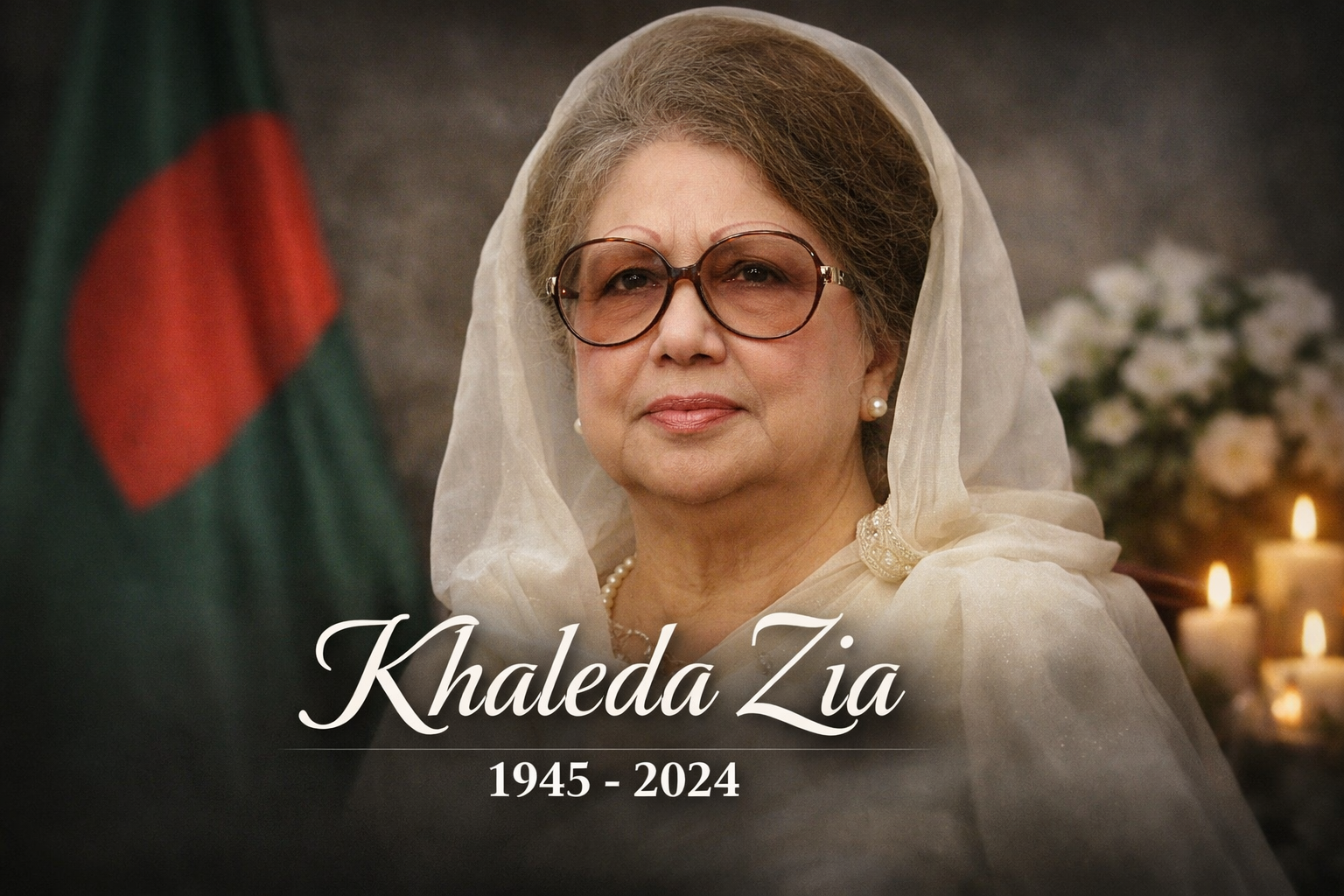
Dhaka: Bangladesh’s first female prime minister and senior Bangladesh Nationalist Party (BNP) leader Khaleda Zia passed away on Tuesday morning at the age of 80, ending a long battle with multiple health complications. The BNP confirmed her death in an official statement.
According to party sources, Khaleda Zia breathed her last around 6:00 am, shortly after the Fajr prayer. In a post shared on the BNP’s official Facebook page, the party expressed deep grief and urged supporters to pray for the forgiveness of her soul.
Doctors treating the former prime minister revealed that she had been suffering from advanced liver cirrhosis, along with chronic conditions such as arthritis, diabetes, and serious heart and chest problems. Her health had remained fragile for several years, significantly limiting her public appearances and political activity.
BNP standing committee member Salahuddin Ahmed stated that Khaleda Zia’s funeral is likely to be held on Wednesday at Manik Mia Avenue in Dhaka, a venue traditionally associated with major state and political ceremonies. Final arrangements are expected to be announced after consultations with the family and party leadership.
A Life Marked by Power, Struggle, and Controversy
Khaleda Zia served as Bangladesh’s prime minister twice, becoming a central figure in the country’s political landscape. However, her later years were overshadowed by serious health issues and prolonged legal battles.
In 2018, she was convicted in a corruption case linked to the misappropriation of funds meant for orphans, stemming from a 2008 investigation. The conviction resulted in a prison sentence, which significantly impacted her political career.
In 2020, then Prime Minister Sheikh Hasina, her long-time political rival, suspended Khaleda Zia’s sentence on humanitarian grounds due to her deteriorating health. However, the suspension came with conditions, including restrictions on foreign travel and political engagement.
Earlier this year, in January, Bangladesh’s Supreme Court acquitted Khaleda Zia, overturning her earlier 10-year prison sentence in the corruption case, marking a major legal relief shortly before her passing.
Khaleda Zia’s death marks the end of an era in Bangladeshi politics, leaving behind a legacy shaped by leadership, rivalry, resilience, and controversy.
The Bangladesh Nationalist Party (BNP) has consistently maintained that the legal cases filed against Khaleda Zia were politically motivated, alleging that the government led by Sheikh Hasina at the time targeted her to sideline the opposition. The party has repeatedly denied any wrongdoing by its chief, calling the charges part of a broader political vendetta.
Bangladesh’s First Woman Prime Minister
Khaleda Zia holds a historic place in Bangladesh’s political history as the country’s first female prime minister. She first assumed office after winning the 1991 general elections and served until 1996. She later returned to power for a second term from 2001 to 2006, making her one of the longest-serving leaders in the nation’s democratic era.
She was the widow of Ziaur Rahman, a former president of Bangladesh and an army chief who played a key role in the country’s political evolution. Following his assassination, Khaleda Zia gradually emerged as a dominant political figure and eventually led the BNP to power through a popular mandate.
After assuming office in 1991, Khaleda Zia played a crucial role in restoring the parliamentary system of governance. Her government also introduced the caretaker government system, a mechanism aimed at ensuring free, fair, and neutral elections, according to reports by The Daily Star. The reform later became a defining feature of Bangladesh’s electoral process.
Arrest, Release, and Political Setbacks
In 2007, during the tenure of an army-backed caretaker government, Khaleda Zia was arrested along with several prominent political leaders, including Sheikh Hasina. She was later released and went on to contest the 2008 parliamentary elections, though the BNP failed to secure victory.
Despite political setbacks and years of legal and health-related struggles, Khaleda Zia remained a towering figure in Bangladeshi politics. She is survived by her elder son Tarique Rahman, his wife, and their daughter. Notably, Tarique Rahman returned to Bangladesh on December 25 after spending nearly 17 years in exile, marking a significant moment for the Zia family shortly before her passing.
Khaleda Zia’s life reflected the turbulent journey of Bangladesh’s democracy, marked by electoral victories, institutional reforms, political rivalries, and personal resilience.