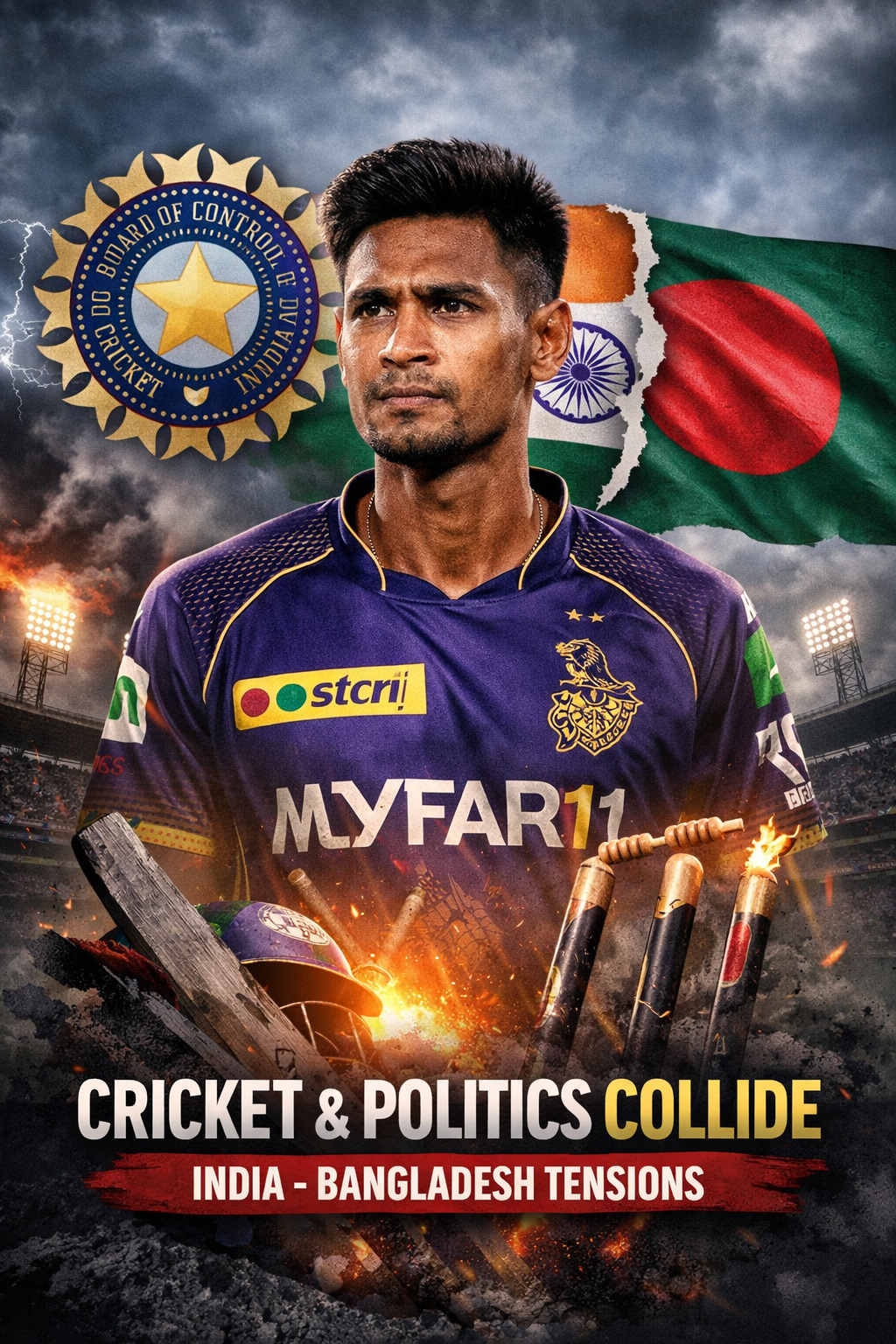
Cricket and politics, once carefully kept apart, are now colliding head-on—and Bangladesh pacer Mustafizur Rahman has become the latest casualty. The Board of Control for Cricket in India’s (BCCI) decision to bar him from the IPL 2026 season reflects how sharply relations between India and Bangladesh have deteriorated in recent months.
To understand how things reached this point, one must look back at the history that once bound the two cricketing nations together. Bangladesh played its first-ever Test match in November 2000 at Dhaka’s Bangabandhu National Stadium—against India. That moment was symbolic. India had played a pivotal role in Bangladesh being granted Test status, thanks largely to the influence of Jagmohan Dalmiya, then president of the International Cricket Council. The breakthrough came after Bangladesh’s memorable win over Pakistan in the 1999 World Cup, a result that signaled their arrival on the global stage.
Although Bangladesh lost that debut Test by nine wickets, their fighting performance earned respect. Over the years, their progress in international cricket has been gradual rather than spectacular, but they have carved out notable moments. Privately, there has long been an acknowledgment in Bangladesh of India’s support—not only in cricket, but historically as well.
However, the warmth that once defined the relationship has steadily faded. On-field rivalries have grown sharper, and off-field politics has driven a deep wedge between the two neighbours. The turning point came after former Prime Minister Sheikh Hasina was overthrown in a violent uprising last August and subsequently took refuge in India. The new government in Dhaka, led by Nobel laureate Muhammad Yunus, has taken a markedly different stance toward India.
Tensions escalated further amid reports of targeted attacks on Bangladesh’s Hindu minority, prompting India to register strong diplomatic protests. Public opinion in India has hardened, especially after the Yunus administration signaled closer engagement with Pakistan—a move that has raised eyebrows in New Delhi.
Against this volatile backdrop, the BCCI’s directive to Kolkata Knight Riders to withdraw Mustafizur Rahman from IPL 2026 begins to make grim sense. At the mini-auction in Abu Dhabi last month, Mustafizur—popularly known as ‘Fizz’—was the only Bangladeshi player to attract serious bids. KKR eventually secured him for a hefty ₹9.20 crore, fending off competition from Chennai Super Kings and Delhi Capitals.
Even then, the decision sparked criticism in some quarters, with KKR co-owner Shah Rukh Khan facing backlash for backing a Bangladeshi player amid strained bilateral ties. Since then, relations have only worsened, culminating in the BCCI’s official order—confirmed by secretary Devajit Saikia—that Mustafizur will not be allowed to participate.
This effectively makes Bangladesh the second country, after Pakistan, whose players are unwelcome in the IPL. Pakistani cricketers featured in the league’s inaugural season in 2008, but were banned following the Mumbai terror attacks later that year. The Mustafizur episode raises the possibility that Bangladeshi players could now face a similar, if unofficial, exclusion.
Signs of trouble had surfaced earlier. Last July, India’s scheduled white-ball tour of Bangladesh—three ODIs and three T20Is—was postponed. While both boards cited “scheduling convenience” in carefully worded statements, the delay was widely seen as politically driven. Though the Bangladesh Cricket Board recently announced dates for the tour in September, the BCCI has remained silent, fueling speculation that the series may not happen at all.
Historically, Bangladeshi players have had limited success in the IPL, with Shakib Al Hasan and Mustafizur Rahman being notable exceptions. Shakib played 71 matches across seasons, while Mustafizur has taken 65 wickets in 60 appearances. For the 30-year-old pacer, losing an IPL contract is not just a professional setback but a significant financial blow.
Yet, given the current climate, the decision was hardly surprising. At last year’s Asia Cup, India had already made its stance clear: sports and politics can no longer be separated. The Mustafizur Rahman case is simply the clearest sign yet that geopolitics has firmly entered the cricketing arena.