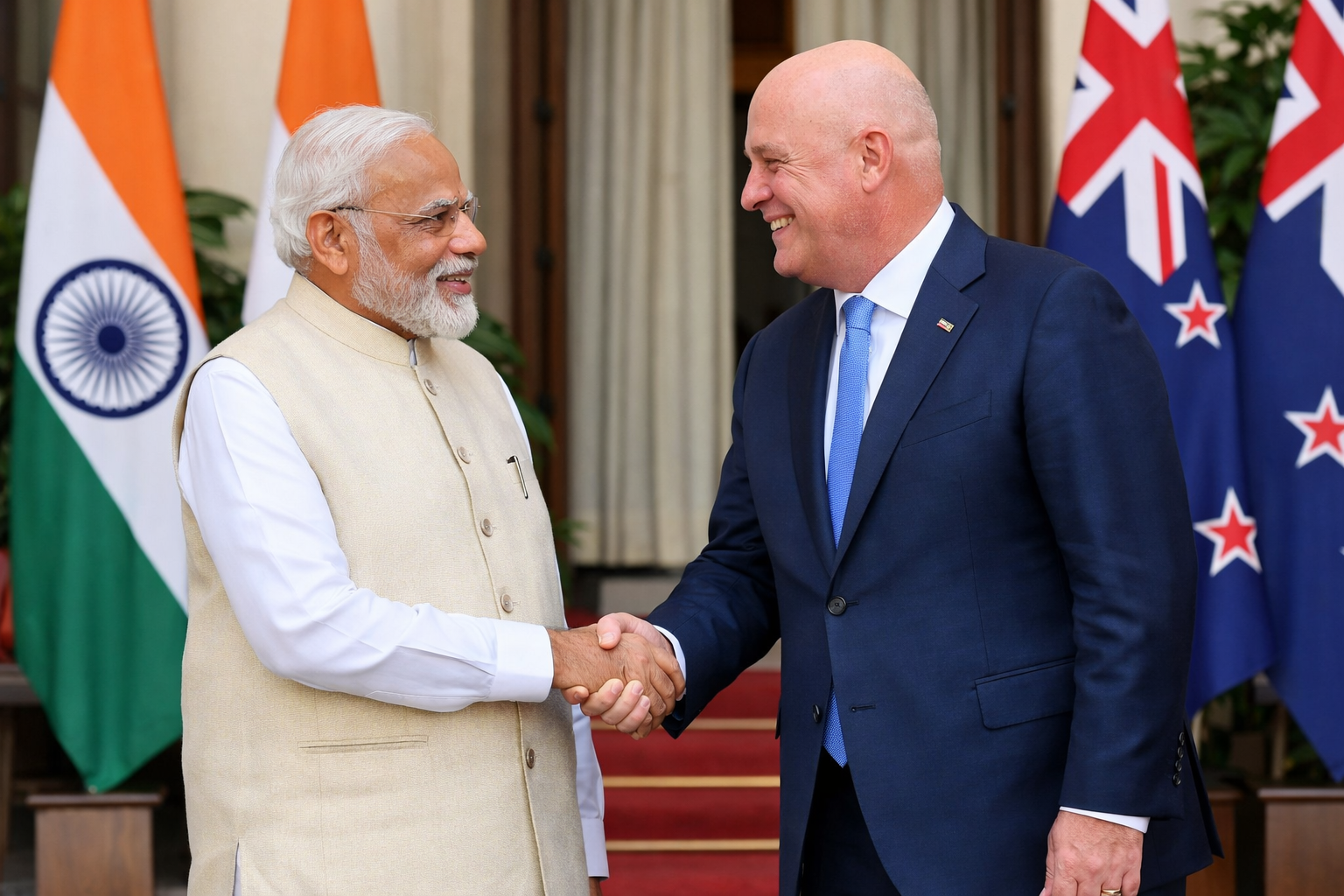
New Zealand Prime Minister Christopher Luxon has strongly defended his government’s newly announced Free Trade Agreement (FTA) with India, describing it as a major milestone for the country’s economic future, even as the deal has sparked disagreement within his ruling coalition.
Welcoming the agreement, Luxon framed it as part of his administration’s long-term vision, saying it aligns with the goal of “fixing the basics and building the future.” He said securing an FTA with India was a key promise made during his campaign and claimed his government has successfully delivered on that commitment.
Highlighting the economic potential of the deal, Luxon said the agreement would create more jobs, boost incomes, and expand export opportunities by providing New Zealand businesses access to India’s massive consumer market of around 1.4 billion people. He called the pact a landmark achievement that would support growth over the coming years.
Internal Rift Over Trade Deal
Despite the prime minister’s optimism, the agreement has exposed clear divisions within New Zealand’s coalition government. Foreign Minister Winston Peters, who leads the New Zealand First (NZF) party, has openly criticised the deal, describing it as “neither free nor fair.”
Peters said he had conveyed NZF’s concerns directly to India’s External Affairs Minister S. Jaishankar, while also expressing personal respect for him. According to Peters, the agreement gives away too much without delivering adequate benefits in return for New Zealand.
Deal Followed Modi–Luxon Talks
The FTA was announced earlier this week following discussions between Prime Minister Narendra Modi and Christopher Luxon. Both leaders said the agreement has the potential to double bilateral trade within five years and could result in investments worth nearly $20 billion in India over the next 15 years.
Negotiations for the trade pact began in March. At the time of the announcement, both sides described the deal as a reflection of shared ambition and strong political will to deepen ties between the two countries.
‘Low-Quality Deal Rushed Through,’ Says Peters
Winston Peters has alleged that the agreement was rushed through without adequate consultation or political consensus. In a detailed post on social media platform X, he said NZF had advised its coalition partner to take more time to negotiate a better outcome.
According to Peters, speed was prioritised over substance. He argued that the government chose a quick deal rather than putting in the effort needed to secure terms that would fairly benefit both nations.
Dairy Sector at the Centre of Dispute
One of Peters’ main objections relates to New Zealand’s dairy industry. He said the FTA opens New Zealand’s market to India without securing meaningful tariff reductions on Indian imports of key dairy products.
Calling it damaging for rural communities, Peters said the agreement is the first trade deal signed by New Zealand that excludes major dairy products such as milk, cheese, and butter. He added that this makes the deal difficult to justify to farmers.
Earlier reports indicated that agriculture and dairy were sensitive areas during negotiations, with both sides agreeing to keep these sectors outside the agreement to speed up progress.
Trade Numbers and Strategic Importance
Trade in goods and services between India and New Zealand stood at $2.07 billion in 2024, with Indian exports accounting for $1.1 billion. India primarily exports pharmaceuticals, while New Zealand exports forestry and agricultural products. According to the Indian government, New Zealand is currently India’s second-largest trading partner in the Oceania region.
Migration and Labour Market Concerns
Peters has also raised concerns about migration provisions in the agreement. He claimed the deal places greater emphasis on easing the movement of Indian workers to New Zealand rather than strengthening two-way trade. He argued that similar labour access has not been extended to other partners such as Australia or the UK.
Questioning the impact on domestic employment, Peters said any changes to migration policy must protect job opportunities for New Zealanders and uphold the integrity of the immigration system. In his view, the India FTA fails to meet that standard by proposing a new employment visa category specifically for Indian citizens, at a time when New Zealand’s labour market is already under pressure.