Union Minister for Parliamentary Affairs and Minority Affairs Kiren Rijiju is at the centre of political action as the government faces an agitated Opposition that wants to take on the ruling dispensation for the ongoing contentious Special Intensive Revision (SIR) of the electoral rolls.
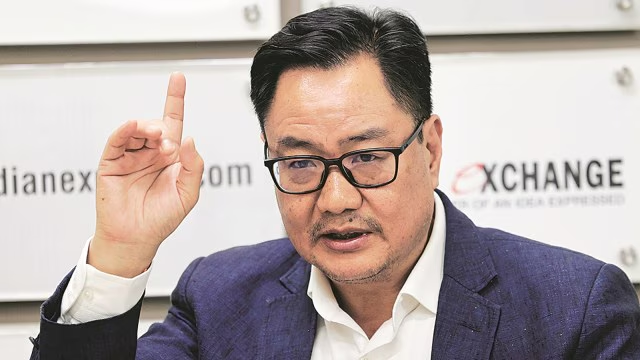
Union Minister for Parliamentary Affairs and Minority Affairs Kiren Rijiju on the reasons for the disruptions on the floor of the House, why the Opposition has to use time wisely, and the safety of minorities in India. This session was moderated by Liz Mathew, Deputy Editor, The Indian Express.
Liz Mathew: The last two parliamentary sessions were a washout. Now that the BJP and the NDA have had an electoral victory in Bihar and with the Opposition against SIR (Special Intensive Revision), what are your expectations for the session?
The last two sessions, despite the disturbances, from the government’s point of view, were successful. In fact, the last session was the most productive one in my more than two decades of parliamentary experience. The washing out of session may be bad, however, for the government, we are worried only because there were no discussions on critical Bills. But from a purely business point of view, we have passed so many Bills so, technically, it’s not a washout session but from the democratic spirit point of view, the disturbances are painful and people don’t like that Parliament rushes through important Bills.It all depends on how the Opposition behaves. The government comes out with the agenda and the Bills and other important businesses are put before the House. Before that, we table the agenda of the Business Advisory Committee (BAC). As Parliamentary Affairs minister, I try to listen to the Opposition’s request for a longer period of time. In the last session, both Operation Sindoor and the Waqf (Amendment) Bill had a record length of discussion. We had given ample time and we agreed to discuss them but if the Opposition doesn’t allow other businesses to be discussed then that is bad.
You have an issue to be taken up in the zero hour, raise it then. When the zero hour is over, then it is time for a Bill or for another subject to be taken up. That is how we can make Parliament function efficiently.
Beyond regular meetings, we also have many courtesy meetings. I am in touch with all the Opposition leaders and they come to my place. I visit them, we exchange information and that will continue. After all, the House belongs to all. But the perception that not enough efforts are being made to get the Opposition on board is not true. For instance, when the matter for the removal of Justice (Yashwant) Varma was taken up, I had a discussion with both the leaders of the Opposition Rahul Gandhiji (Lok Sabha) and Mallikarjun Khargeji (Rajya Sabha). And then we agreed that we will take up this matter in Lok Sabha.
We may have differences in a parliamentary democracy but trust and ethics are an important part of the procedure and the rules of business laid down. Once the trust is broken, it leads to a cascading effect on how the normal routine works. Another thing I wanted to suggest to the Opposition is that if they want to use Parliament for their political purpose, then they should use it more wisely. Disrupting proceedings and misusing the Parliament forum for driving political agenda does not necessarily bring them political dividends. Political differences will remain but Parliament should not become the victim.